
What to Expect at Cape Coast and Elmina Slave Dungeons in Ghana
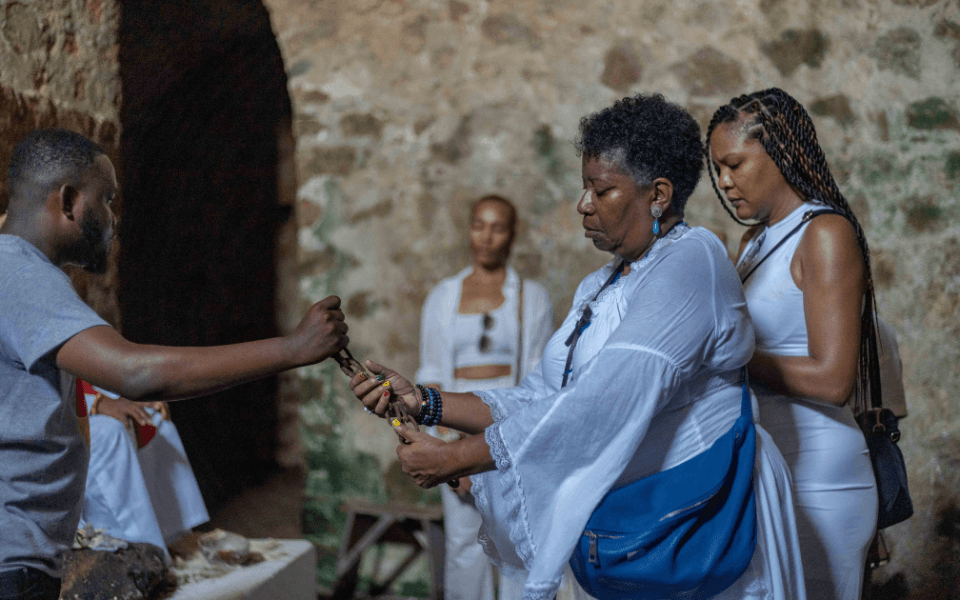
There is a moment, when you step through the Door of No Return at Cape Coast Castle and feel the Atlantic wind rise to meet you, that something shifts inside you. Something you cannot name. Something that has been waiting a very long time for this exact encounter.
The slave dungeons are not easy places to visit. They were not built to be. The castles at Cape Coast and Elmina were the last African soil that millions of our ancestors touched before being loaded onto ships and carried across the Middle Passage into lives of forced bondage. Walking through them is an act of witness, and for many in the diaspora, it is one of the most profound experiences of their lives.
This guide is for those who are ready to make that journey. We will walk you through what to expect when you visit Ghana's slave dungeons, the history, the emotional reality, the practical details, and how to prepare yourself for an experience that will stay with you long after you return home.
Understanding the History of Slave Dungeons in Ghana
To stand in Cape Coast Castle or Elmina Castle, two of the most-visited Ghana slave dungeons, without understanding their history is to miss the full weight of what you are standing inside. These were not simply prisons; they were slave dungeons in Ghana that formed the infrastructure of one of the greatest crimes in human history.
These castles were built by European colonial powers, the Portuguese at Elmina in 1482, the British at Cape Coast in the 1600s, and served as holding spaces for enslaved Africans before their forced transportation across the Atlantic. At their peak, they held thousands of human beings in dungeons barely large enough to stand in, with little food, no sanitation, and no light. Many did not survive the wait. Those who did were marched through the Door of No Return onto ships, and into lives their descendants are still working to understand.
Today, both Cape Coast Castle and Elmina Castle are UNESCO World Heritage Sites. They are also living memorials, places where the history is not behind glass but beneath your feet, in the walls around you, in the air you breathe. The Ghanaian government, alongside diaspora organizations, has invested significantly in preserving these sites, interpreting them with honesty, and making them accessible to those whose ancestors passed through them.
Understanding this history before you arrive does not make the experience easier. But it gives you the context to receive it fully.
Cape Coast Castle: What to Expect
Cape Coast Castle sits on a rocky promontory above the Gulf of Guinea, whitewashed and imposing against the deep blue of the Atlantic. From a distance, it looks almost beautiful. That contrast ‘beauty above, horror below’ is part of what makes visiting it such a disorienting and important experience.
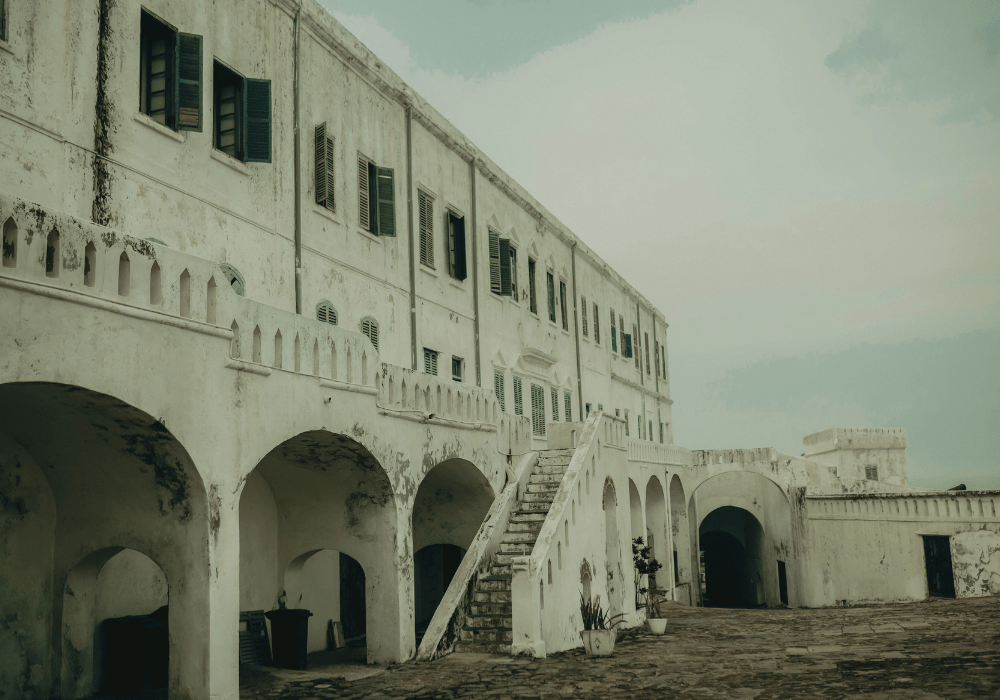
Cape Coast Slave Castle, Ghana
The Male Dungeons
The male slave dungeons at Cape Coast Castle held between 1,000 and 1,500 men at a time in conditions that are difficult to comprehend even standing inside them. The floors are dark with centuries of human sediment. The ventilation holes near the ceiling were the only source of air. There was no light, no sanitation, no space to lie down. Guides will tell you, with quiet precision, exactly what happened in these rooms. Listen carefully. What they share highlights the truth that deserves to be held.
The Female Dungeons
The female dungeons tell a different and equally devastating story. Enslaved women were held here in similar conditions, but were also subject to the additional violence of sexual exploitation by the castle's officers. The rooms are smaller. The details shared by guides are specific and unflinching. Many travelers find these rooms the hardest to stand in.
The Door of No Return
The Door of No Return at Cape Coast Castle opens directly onto a small stone platform above the ocean. Through this door, enslaved Africans were loaded directly onto small boats that carried them to the waiting ships. Many travelers say that standing in this doorway, looking out at the same Atlantic their ancestors looked out at, knowing what awaited them, is the single most powerful moment of their lives.
In 2019, as part of Ghana's Year of Return commemorations, the door was renamed the Door of Return. It is a symbol of welcome to the diaspora coming home. When you walk back through it, you are completing a circle that has been waiting centuries to close.
The Governor's Quarters and Chapel
Directly above the male dungeons and separated by a few feet of stone are the governor's quarters and an Anglican chapel. The juxtaposition is one of the most morally confronting aspects of the tour. The same structure that held enslaved human beings in total darkness hosted Sunday services above them. Guides address this directly and without apology. The contradiction deserves to be named.
Elmina Castle: What to Expect
Elmina Castle, located about 12 kilometers west of Cape Coast, is the oldest European building in sub-Saharan Africa. Built by the Portuguese in 1482 and later seized by the Dutch, it operated as a slave-trading post for over three centuries. It is a larger, more complex structure than Cape Coast Castle, and the tour experience reflects that complexity.
The Slave Dungeons
The dungeons at Elmina are below sea level. At high tide, seawater seeps through the walls. The rooms are damp, dark, and carry an almost physical weight. The guides at Elmina are among the most knowledgeable on the coast. Many are descendants of communities that have been custodians of this history for generations. What they share is not a performance. It is a transmission.
The Condemned Cell
One of the most harrowing rooms in Elmina Castle is the condemned cell. The cell is a completely sealed, windowless room where enslaved people who resisted or were deemed troublesome were locked without food, water, or light until they died. A small skull-and-crossbones marking on the door still remains. Most visitors stop speaking when they enter this room.
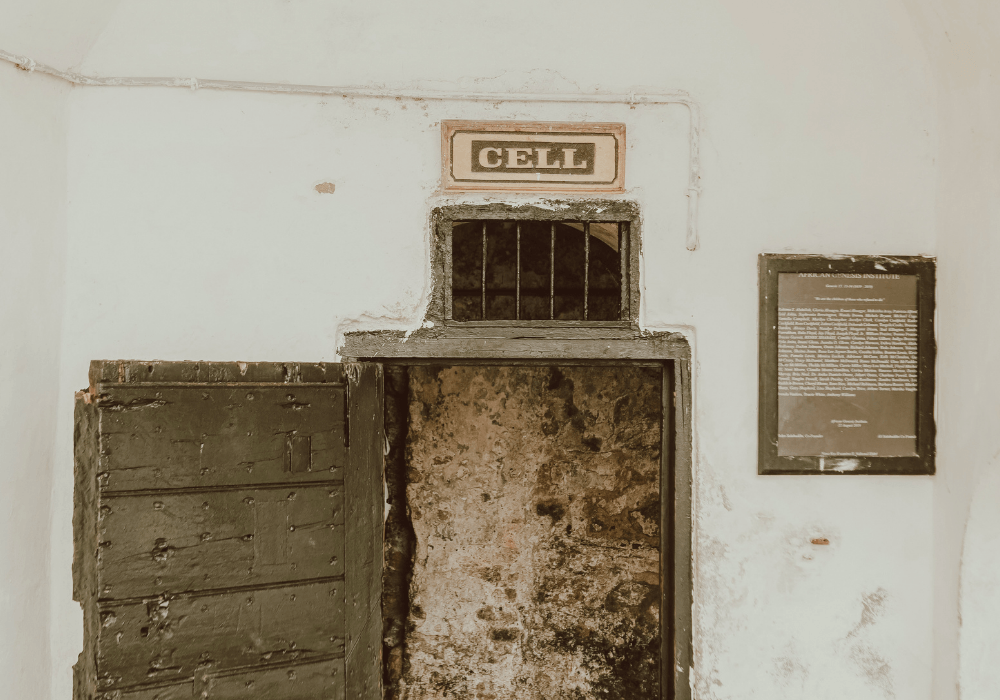
Condemned Cell at a slave castle in Ghana
The Elmina Township
Unlike Cape Coast Castle, Elmina Castle sits within a living town, the same town that has existed alongside it for centuries. After the tour, walking through Elmina's market streets, watching fishermen bring in their catch, hearing children playing in the lanes, you experience something important: life continued. Community endured. The town of Elmina itself is part of the story of survival and continuity.
How to Prepare Yourself Emotionally
We will not tell you that visiting Ghana's slave dungeons will be easy. Many of our travelers have said it was the most emotionally demanding experience of their lives, and also the most important. The key is to prepare, not to armor yourself against feeling, but to create the conditions to feel fully and safely.
Permit yourself to feel whatever arises: Tears, anger, grief, numbness, even unexpected peace, all of it is a valid response. There is no correct way to experience these spaces.
Do not rush the tour. Allow yourself to stop when you need to. Linger in the spaces that call for it. If you need to step outside, step outside.
Consider traveling with a community: Many diaspora travelers find that sharing this experience with others who hold the same heritage deepens the experience profoundly. The collective witness matters.
Bring something to write with: Many travelers find that journaling during or after the visit helps process what arises. Others bring an offering: flowers, wreaths, a letter, a photograph of an ancestor, as an act of honoring.
Plan for the rest of the day: After visiting the castles, most people need quiet time. A space to process, to sit with the ocean, to eat slowly, to simply be present. Do not overschedule the hours after your visit.
Practical Information for Your Visit
Getting There
Cape Coast is approximately three hours from Accra by road. The most comfortable option is a private transfer, which Protour Africa arranges as part of every heritage itinerary. Elmina is a 15-minute drive west of Cape Coast, making it easy to visit both sites in the same day. However, we recommend giving each site the full time and attention it deserves, ideally on separate days.
Opening Hours and Entry Fees
Both Cape Coast Castle and Elmina Castle are managed by the Ghana Museums and Monuments Board and are open daily. Entry fees are modest by international standards. Guided tours are included in the entry fee and are the only way to fully experience the sites. The guides carry knowledge, context, and personal connection to this history that no self-guided visit can replicate.
What to Wear and Bring
Dress comfortably and respectfully. The dungeons are cool even in the heat of the day. Comfortable walking shoes are essential, the castle floors are uneven stone. Bring water. Bring a small notebook. Leave the phone in your bag for portions of the tour where being fully present matters more than documentation.
Photography
Photography is permitted in most areas of both castles. We ask that travellers approach this with reverence. These are sacred spaces. A photograph taken with presence and intention is a meaningful act of documentation. A photograph taken carelessly in a space of profound suffering is not.
Beyond the Dungeons: The Broader Heritage Coast
Ghana's heritage is not confined to the castles. The Central Region is home to beautiful landscapes and a vibrant cultural heritage that extends far beyond Cape Coast and Elmina, encompassing other forts communities that endured alongside them.
Assin Manso Ancestral Slave River Site: Where enslaved Africans were bathed for the last time in fresh water before being marched to the coast. The site now holds the remains of two diaspora individuals: Kwame Sampong (originally from Ghana) and Crystal, an African American woman, who were repatriated and reburied here as symbols of return.
Kakum National Park: A short distance from Cape Coast, Kakum offers a profound contrast: ancient forest canopy, birdsong, and the deep green of a living ecosystem. Many travelers find the park a necessary counterpoint to the weight of the castles.
The town of Cape Coast itself: A historic town with deep colonial and ancestral layers, Cape Coast rewards slow exploration. Its markets, its fishing harbor, and its community rhythms all contribute to a fuller understanding of Ghanaian life, past and present.
Other Castles and Forts to Explore in Ghana
Beyond Cape Coast and Elmina, Ghana's coastline holds a remarkable collection of castles and forts that are rarely spoken about but carry an equal weight of history. For the diaspora traveller willing to go beyond the well-known sites, they offer something profound: a fuller picture of the scale of what happened on this coast, and the depth of the heritage that Ghana holds.
Fort Amsterdam, Abandze
Originally built by the British in 1631 and later seized by the Dutch, Fort Amsterdam sits in the small fishing community of Abandze, largely unrestored and quietly powerful. Unlike the more visited castles, Fort Amsterdam has been left largely as time found it, which means walking through it feels less like a museum visit and more like a direct encounter with history. The local community serves as custodians of the site, and the experience of visiting with a community guide carries an intimacy that larger sites cannot always offer.
Fort Saint Jago, Elmina
Overlooking Elmina Castle from a hill directly above it, Fort Saint Jago was built by the Dutch in 1652 to defend Elmina Castle from attack. Standing at Fort Saint Jago and looking down at Elmina Castle and the town below gives you a perspective on the geography of the slave trade that changes how you understand everything at ground level. The walk up is steep, and the fort is partially ruined, but the view and the silence are extraordinary.
Fort Patience, Apam
Built by the Dutch in the late seventeenth century, Fort Patience sits above the fishing town of Apam. It is one of Ghana's less-visited heritage sites, and that quietness is part of its power. The fort has been partially restored and offers a contemplative space for reflection that the busier heritage sites, for all their importance, cannot always provide.
Fort Metal Cross, Dixcove
Located in the western coastal town of Dixcove, Fort Metal Cross was built by the British in 1692 and remains one of the best-preserved forts on the Ghana coast. The journey to Dixcove itself through the lush landscapes of the Western Region is part of the experience. The fort sits above a fishing community whose relationship with this history stretches back generations, and engaging with that community is as meaningful as the structure itself.
Fort Apollonia, Beyin
The westernmost fort on the Ghana coast, Fort Apollonia, sits near the Nzulezu stilt village. It is one of Ghana's most extraordinary and least-visited cultural heritage sites, where an entire community lives on platforms built over a lagoon. Combining Fort Apollonia with a visit to Nzulezu makes for one of the most layered and memorable days available anywhere in Ghana.
Christiansborg Castle (Osu Castle), Accra
Perhaps the most historically layered of all Ghana's castles, Christiansborg, built by the Danes in the seventeenth century and later used as the seat of Ghanaian government after independence, sits in the heart of Accra's coastal district. Its history moves from the slave trade through colonial administration to post-independence governance, making it a structure that holds the full arc of Ghanaian history within its walls. Access has been periodically restricted due to its governmental role, but guided heritage visits are available and deeply worthwhile.
Visiting these sites alongside Cape Coast and Elmina does not dilute the experience of the more famous castles; it deepens it. The full scale of what happened on this coast cannot be grasped by visiting only the castles. I recommend adding something about the people and their history, especially communities along the coast and their connection to the castle.
Conclusion
For many diaspora travelers, visiting the Ghana slave dungeons is one of the most significant things they will ever do. It is an act of honoring. An act of completing a circle. An act of saying to every ancestor who passed through those doors: I came back. I found you. I remember.
When you are ready to take your journey home, check out this Panafest journey to Ghana
Q&A
Question: Why do Cape Coast and Elmina castles matter, and what does it mean to visit as an “act of witness”?
Answer: These castles were central to the transatlantic slave trade and final holding sites where enslaved Africans were confined in brutal conditions before the Middle Passage. Today, as UNESCO World Heritage Sites and living memorials, their history is felt in the stone, air, and stories carried by local guides. Visiting is an act of witness because you’re standing where millions suffered, honoring their lives and acknowledging a truth that shaped the world.
Question: How do Cape Coast and Elmina differ, and should I visit both?
Answer: Cape Coast Castle is starkly juxtaposed by male and female dungeons below, with the governor’s quarters and an Anglican chapel directly above, confronting you with moral contradictions. Elmina Castle, older and larger, sits within a living town; its dungeons are below sea level, and the condemned cell is among the most harrowing spaces you’ll encounter. Guides at both sites offer deeply informed, unflinching context. You can see both in one day (they’re 15 minutes apart), but giving each a separate day allows the space and attention their histories deserve.
Question: What should I expect emotionally, and how can I prepare?
Answer: Expect intensity, grief, anger, numbness, and even unexpected calm are all valid. Prepare by allowing yourself to feel without rushing; pause or step outside if needed. Consider going with community; shared witness can deepen and support the experience. Bring a journal or a simple offering (flowers, a letter, a photo of an ancestor) to help you process and honor the space.
Question: What should I wear and bring, and how should I approach photography?
Answer: Dress comfortably and respectfully; wear sturdy walking shoes for uneven stone floors, and bring water and a small notebook. The dungeons can be cool even on hot days. Photography is allowed in most areas, but treat the sites as sacred: prioritize presence over documentation. Take photos with intention, and be prepared to put your phone away in moments and spaces where full attention and reverence matter more than images.
Question: How do I plan the visit?
Answer: Cape Coast is about a three-hour drive from Accra; private transfers (which Protour Africa can arrange) are the most comfortable option. Both castles are managed by the Ghana Museums and Monuments Board, open daily, and include guided tours in the entry fee.

Date-Jul 2026 & Jul 2027 Number of days-10 days
This tour is curated for guests seeking the deep continuity of their Pan-African heritage. Rather than beginning with the immediate emotional weight of the coastal dungeons, this journey starts at the northern trade routes, where it all began. Follow with participation in the PANAFEST festival and conclude with the natural majesty of the Volta Region of Ghana.