
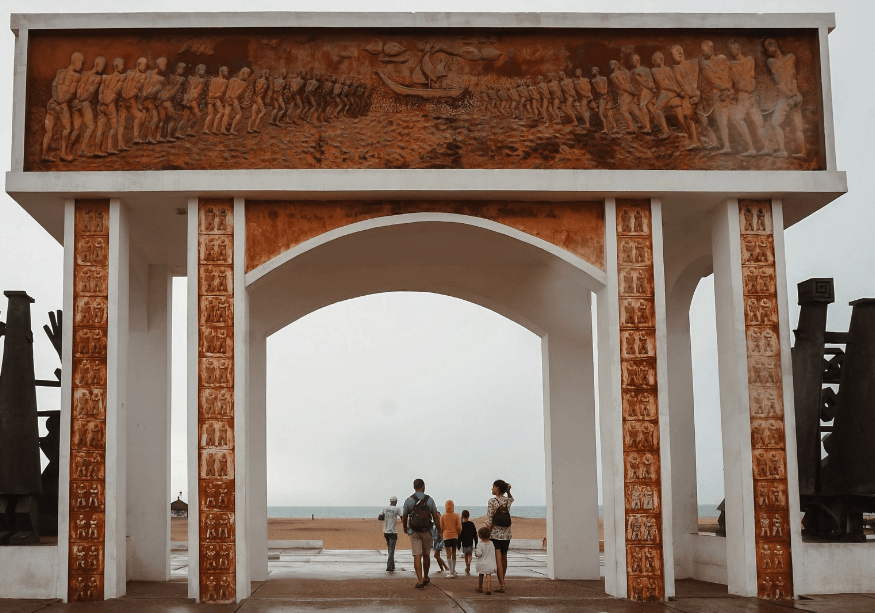
There are places in this world where the ground itself holds memory. Where the air carries something older than words, something that does not need a tour guide to explain itself. Ouidah is one of those places. And the Door of No Return, standing at the edge of the Atlantic, is one of the most sacred thresholds a person of the diaspora can cross.
Most who feel the pull of African heritage travel have heard of Cape Coast Castle in Ghana. It has become, rightly, one of the most visited and deeply felt heritage sites on the continent.
But there is another Door of No Return. One that fewer people know. One that stands not within stone walls but at the edge of open sky and Atlantic water, along a route that was once walked by tens of thousands of captive souls. That door is in Ouidah, Benin.
In this blog, we discover the history of the Door of No Return in Ouidah and a guide to visiting.
What Is the Door of No Return in Ouidah?
The Door of No Return in Ouidah is not a building. It is a monument, an arched gate on the beach of Ouidah. It was erected in 1992 by the Beninese government in partnership with UNESCO, marking the precise stretch of coastline where enslaved Africans were forced onto ships bound for the Americas.
It stands at the end of the Route des Esclaves, the Slave Routes, a 4-kilometre path that has been walked by the condemned, the grieving, and now, by those who return.
To understand why this site carries such particular weight, you must understand Ouidah's history.
The History of Ouidah
For nearly two centuries from the early 1600s through the late 1800s , Ouidah was one of the most active and brutal slave trading ports on the entire West African coast. It is estimated that more than one million people were shipped from this shore. One million lives. One million stories. One million lines of ancestry severed in the sand.
They were held in barracoons, holding pens, before being marched down what is now the Route des Esclaves to the sea. Some of those people were Yoruba, Fon, Ewe, Bariba. Many of their descendants became the ancestors of African Americans, Afro-Brazilians, Afro-Cubans, Haitians.
The Vodoun religious traditions carried to Haiti and Brazil. The rhythmic foundations of American blues and gospel, the culinary memories of West African cooking that survived the Middle Passage, much of this traces, in part, back to this coast.
The Door of No Return in Ouidah is where that story was broken. It is also where it can begin to be restored.
The Route des Esclaves: Walking the Path of No Return
The Route des Esclaves, the Slave Route, is the true heart of any visit to Ouidah. This 4-kilometre path begins in the centre of town, near the old Portuguese Fort, and ends at the beach and the Door of No Return monument.
Walking it is not a comfortable experience. It is not meant to be.
Along the route, you will encounter a series of monuments and markers, each one holding a specific piece of history.
The Tree of Forgetfulness
Near the beginning of the route stands a replica of the Tree of Forgetfulness. Enslaved Africans were forced to walk in circles around this tree. Men nine times and women seven times as part of a ritual intended, in the ideology of those who enslaved them, to make them forget their identity, their homeland, their name. Those who designed this ritual understood that memory and identity are the same thing. That to truly enslave someone, you had to try to erase who they were.
The tree does not stand as a monument to that erasure. It stands as a monument to the attempt and to the fact that it failed. Memory survived. It came back across the water in the rhythms of drums, in the way people gathered, in the spiritual practices that would not be extinguished.
The Tree of Return
Near the end of the route stands the Tree of Return. Here, enslaved Africans were said to have walked around the tree three times, silently committing their spirit to return to the land of their ancestors after death, even if their body could not. It is a profound act of spiritual defiance, a refusal to accept that this departure was final.
For diaspora travellers making the journey today, the Tree of Return holds extraordinary resonance. The return that was made spiritually, in an act of faith and resistance, is now made physically. You are the completion of that circle.
The Mass Grave
Along the route, a monument marks the location where those who died during captivity, before they could even be shipped, were buried in mass graves. Standing here requires a different kind of stillness. This is a site of loss without the consolation of a symbolic return. It is a site for bearing witness.
The Door of No Return Monument
At the end of the route, at the edge of the Atlantic, stands the arch. It faces the sea. Beyond it, the ocean that carried away a million people. The same ocean that connects this shore to the Americas, the Caribbean, and Brazil.
Many travellers walk through the arch toward the water and then turn around, walking back through it in the other direction. The gesture is simple. Its meaning is everything.
Ouidah Beyond the Route: The Living Heritage
Ouidah is not only a site of historical trauma. It is a living city, with a culture of extraordinary depth and complexity. It is one that grew directly out of the history this place holds.
The Temple of Pythons
Ouidah is the spiritual heartland of Vodoun. This is the religious tradition that was born in West Africa and carried across the ocean by enslaved people to become Haitian Vodou, Cuban Santería, and Brazilian Candomblé. The Temple of Pythons in the centre of town is one of the most important Vodoun sacred spaces on the continent. The python is sacred here, a messenger between the human and spiritual worlds. Visiting with respect and with an understanding of the tradition's depth transforms the experience from curiosity to genuine encounter.
The Festival International du Vodoun
Held each year on 10 January, Vodoun National Day in Benin is one of the most spiritually significant cultural events in all of West Africa. If your journey brings you to Ouidah in January, you are not watching a performance. You are witnessing a living tradition, continuing itself in real time. The celebrations are vibrant, colorful, deeply spiritual, and profoundly connected to the diaspora heritage that carried Vodoun across the world.
The Portuguese Fort and Museum
The old Portuguese Fort, Fort São João Baptista de Ajudá , now operates as a museum. It stands as one of the most sobering reminders of the colonial infrastructure that made the slave trade possible. Walking through it with the knowledge of what was coordinated within those walls is an act of historical reckoning.
The Brazilian Quarter
One of the most remarkable and bittersweet legacies of the transatlantic slave trade visible in Ouidah is the Brazilian Quarter. It is an architectural and cultural district that tells the story of Afro-Brazilians who returned to West Africa in the 19th century after emancipation, bringing with them Brazilian architecture, language, food, and culture. These were descendants of the enslaved who came back. Their buildings still stand. Their descendants still live in Ouidah. The circle they completed is written into the walls of the city.
Ouidah vs Ghana: Two Doors, One Journey

For diaspora travelers, a natural question arises: Cape Coast or Ouidah? Ghana or Benin? The answer is not either/or. These are not competing destinations. They are chapters in the same story.
Cape Coast Castle in Ghana offers the visceral, enclosed reality of the castle dungeons. The dark holding chambers, the physical architecture of captivity, the Door of No Return that opens from stone walls directly to the sea. It is a site that confronts you with the intimate horror of what was done to people within four walls.
Ouidah offers something different: the scale of the open sky, the length of the route, the spiritual layering of a culture that processed this history through religion and ceremony and returned to build a living culture from it. The Door of No Return in Ouidah faces an open horizon.
Both are essential. Both are doorways to different dimensions of the same heritage. And for travellers whose journey is truly about return, not sightseeing, but homecoming. Experiencing both is an act of wholeness.
There are journeys designed to hold both in a single arc of return. To walk the Route des Esclaves in Ouidah and then to stand at the Cape Coast Castle door. To visit in the same spirit that both were meant to call forth: the spirit of Sankofa. Go back and get it.
How to Visit the Door of No Return in Ouidah: What You Need to Know
Getting to Ouidah
Ouidah is approximately 40 kilometres west of Cotonou, Benin's largest city and its main entry point for international travellers. The drive from Cotonou to Ouidah takes approximately 45 minutes by road.
Cotonou's Cadjehoun International Airport receives direct flights from several West African cities, and connections from European hubs. From Ghana, Ouidah can be reached by road. The border between Ghana, Togo, and Benin is crossable, and this overland route is itself part of the heritage experience: following the coastal road that runs along the shore that once connected these slave trading ports.
When to Go
The dry season in Benin runs from November through April, making this the most comfortable time for travel. If attending the Festival International du Vodoun is part of your journey, plan around 10 January.
Avoid the peak rainy season (June through September) if possible, though the green landscape carries its own particular beauty.
How to Experience the Route des Esclaves
The Route des Esclaves can be walked independently, but to understand fully what you are walking through, the significance of each monument, the history of each site, you need a guide who carries this knowledge not as information, but as inheritance.
The difference between walking the route with a culturally grounded guide and walking it alone is the difference between reading the words of a language you do not speak and hearing someone you trust translate not just the words but the weight beneath them.
Practical Considerations
Benin is a country that welcomes visitors with warmth. French is the official language, and while English is spoken in tourist areas, learning a few words of French and even a greeting in Fon goes a long way as an act of respect.
The currency is the West African CFA franc. The political climate in Benin is relatively stable by regional standards. As with all travel in West Africa, standard health precautions apply: malaria prophylaxis, up-to-date vaccinations (including yellow fever, which is required for entry), and travel insurance.
What to Carry With You
Beyond the practical sun protection, water, comfortable shoes for the walk, carry the willingness to feel whatever arises.
Conclusion
Heritage travel to sites like the Door of No Return in Ouidah is unlike any other kind of travel. It asks something of you that a beach holiday or a city break does not. It asks for your full presence, your emotional courage, and your willingness to carry something home with you that you did not arrive with.
This is not a warning. It is an invitation.
The travellers who are most transformed by the journey of return are the ones who prepare for it. Those who read the history before they arrive, who understand what they are about to witness, who arrive not as tourists looking for spectacle but as family members honouring a long-overdue homecoming.
And we hope the guide to visiting the Door of no return in Ouidah has prepared you to take the journey in confidence.
Remember, the Door of No Return has another name, whispered by those who have walked through it and turned back around:
The Door of Return.
When you are ready , we will be here to guide you through the journey. Get in touch with Protour Africa.

Date-Jul 2026 & Jul 2027 Number of days-10 days
This tour is curated for guests seeking the deep continuity of their Pan-African heritage. Rather than beginning with the immediate emotional weight of the coastal dungeons, this journey starts at the northern trade routes, where it all began. Follow with participation in the PANAFEST festival and conclude with the natural majesty of the Volta Region of Ghana.